After the mid-1930s clinic glow came engineering scale-up, corporate ambition, internal conflict and a slow institutional winter. This chapter covers Beam Ray, Philip Hoyland, legal warfare, and the Crane–Marsh era that carried fragments of the technology into the 1950s–60s.
Beam Ray Corporation and the clinical machine
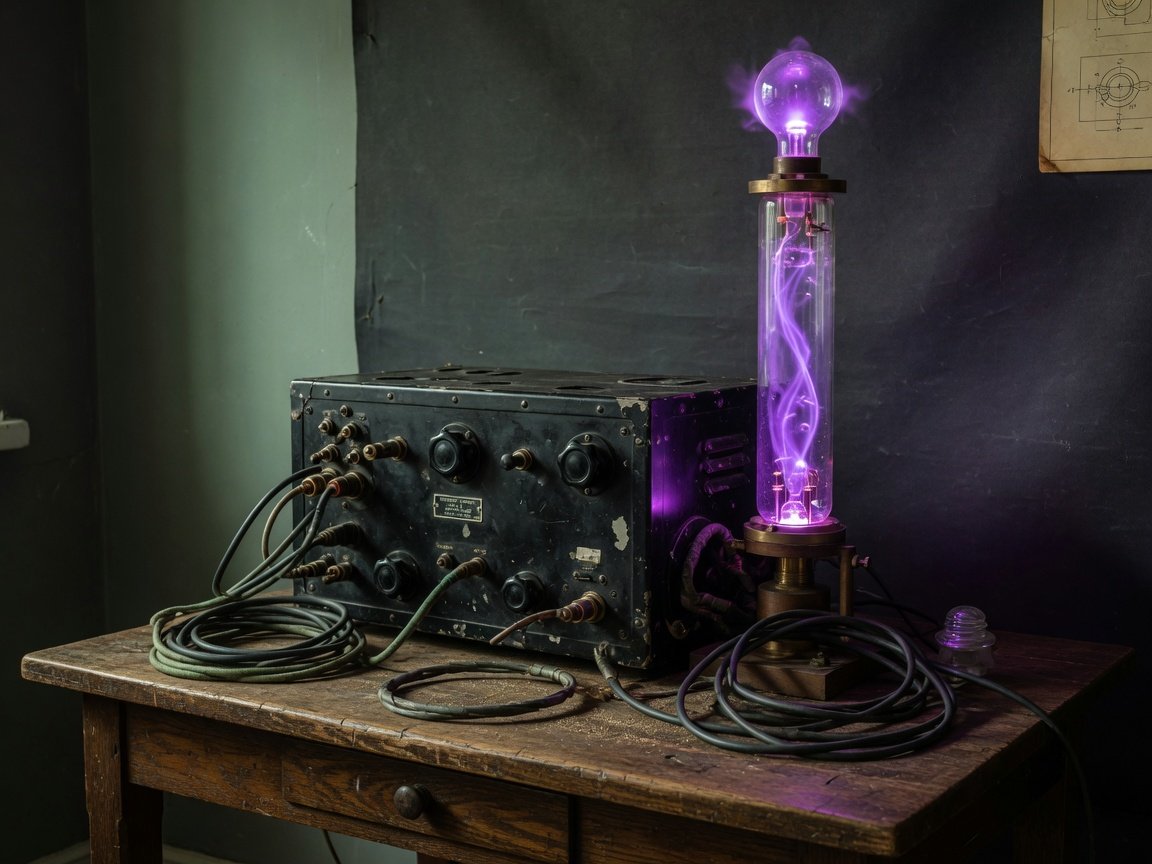
By the late 1930s, commercial energy gathered around instruments sold to doctors. Educational machine histories highlight the Rife Ray #5 / Beam Ray Clinical line — especially designs associated with engineer Philip Hoyland — as the ancestor that most modern “Rife-like” generators unknowingly gesture toward.
Technical summaries from researchers who analysed surviving examples emphasise:
- M.O.P.A.-style (master oscillator / power amplifier) thinking in clinical hardware culture;
- two-frequency / harmonic sideband strategies rather than only naïve single-tone audio playback;
- RF power levels and tube delivery that low-end modern replicas may not match.
Rife’s relationship to Hoyland’s methods was not a fairy-tale partnership. Accounts describe initial dislike of certain two-frequency approaches, later laboratory acceptance when microorganism effects seemed real to them, and then business arrangements that fragmented control among Rife, Hoyland, managers and British licensing interests.
The 1939 legal storm
Trial transcripts preserved and re-transcribed by specialist archives (Hoyland versus Beam Ray Corporation materials) show a fight over control of machines and frequencies — not a calm scientific seminar. Percentages of interest, management appointments, and British contracts appear in testimony. For historians, the trial is gold: it freezes technical and commercial claims under oath. For the public legend, it is often reduced to “suppression,” which is too simple. There was genuine internal corporate warfare and external medical-political pressure.
Mid-century use and regulatory rejection
Through the 1940s–50s, a smaller set of physicians continued frequency-instrument use. Popular tallies sometimes claim on the order of a hundred instruments in circulation internationally across decades — a figure that should be treated as order-of-magnitude lore pending serial-by-serial proof.
What is clearer in press memory is the late-1950s California Department of Public Health confrontation: claims of effectiveness were judged inadequately substantiated; the frequency instrument was branded, in board language reported later, a useless device. Equipment seizures and ruined reputations populate the bitter version of the story Rife himself endorsed in affidavits accusing medical organisations of war on his virus-microscope institute.
John Crane, John Marsh and the AZ-era afterlife
After the glamorous 1930s, partners John Crane and John Marsh become central to how audio memories, instrument variants and business attempts survived. Crane’s legal ordeal (conviction later reversed on grand theft charges, in the framing of 1971 press) became part of Rife’s own sense of persecution. Marsh and Crane also preserved hours of recorded conversation — the raw ore later mined by documentary makers for “Rife in his own words.”
Instrument lineages into the 1950s (including AZ-class ray-tube machines discussed in specialist rebuild literature) show the technology did not vanish; it went sideways into semi-private practice and contested commerce.
Laboratory film and memory media
The 1939 laboratory film tradition — cancer-virus research imagery in Rife’s lab — remains one of the most visceral educational artefacts. Combined with 1950s audio, it is why Rife can still speak in the first person to new audiences without living witnesses.
Reading conflict without conspiracy cartoons
- Yes, pharmaceutical and regulatory cultures of the antibiotic age had little room for electronic ray clinics.
- Yes, internal secrecy and missing patents made replication harder and mythology easier.
- No, not every failure was a midnight murder plot; careful educators explicitly reject unproven murder claims about Rife or Johnson that still circulate online.
Next: how the story returned, and how a modern complementary clinic should talk about it.